
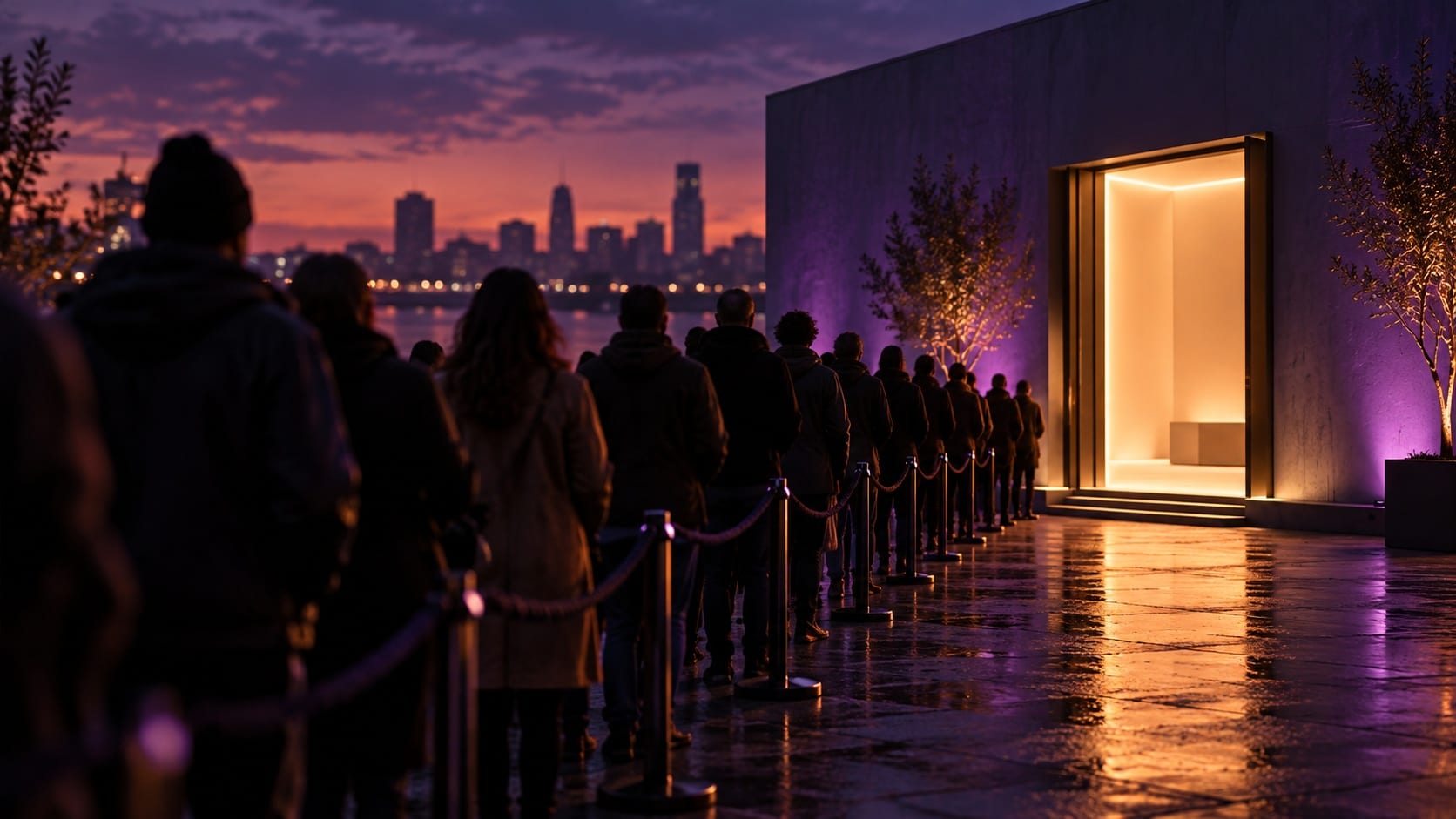
Picture this scene. On a Friday afternoon, the queue in front of a pop-up store wraps around the corner of the building. The person in charge counts the people going in and feels relieved. Today, too, there are lots of people. But no one has yet asked what the people at the end of the line will take away from this space.
Is a pop-up with a long queue a success? It is a long-held assumption, but we rarely look closely at what that assumption is measuring. This article holds on to that question and follows a few sources.
A Market That Isn't Cooling Down
Pop-up agency Sweetspot, citing data from the pop-up information platform POPGA, said 2,130 pop-up stores opened in the first half of 2026. That is 44.7% more than the 1,470 in the first half of last year. The monthly average is 355, more than three times the 113 per month in the first half of 2024. It also said re-openings by brands that had run a pop-up before made up about 18% of the total.
The more pop-ups open, the harder it becomes to tell them apart by a queue alone. That is because several similar queues form in the same alley. The question that remains is one: what were you trying to do after getting people to line up?
Same Queue, Different Goals
In a November 2025 article, Sweetspot explained pop-up KPIs (key performance indicators) by goal. The point is that even with the same budget, the space and the way it is run change depending on what the goal is. The company noted that securing space in a major district such as Seongsu-dong or The Hyundai Seoul, with experience elements and operating staff, basically costs KRW 100 million or more. This is the agency's own estimate basis, so there is no need to read it as a figure that applies unchanged to every pop-up.
- Awareness — The metric is exposure. If someone noticed the pop-up from its exterior without stepping inside, the brand is counted as having been made known.
- Purchase conversion — The metrics are number of payments, purchase rate after the experience, and membership sign-up rate. It is explained that when the experience area and the checkout area are far apart, decisions get interrupted.
- Brand experience — The metrics are participation rate and dwell time. It looks at how long visitors stayed and how closely they followed the intended route.
Seen through this division, which goal does the visitor count serve as a metric for? If awareness is the goal, people passing outside the door may matter more. If conversion is the goal, the people standing at the checkout matter more than those who came in. If experience is the goal, queue length can even become pressure that shortens dwell time. The same number can be a result or background noise depending on the goal.
Measuring the Numbers Beyond the Queue
Musinsa held a pop-up store in Tokyo for 17 days, from April 10 to 26, 2026, and said on April 29 that about 75,000 people visited. It reported an average of about 4,400 visitors per day, with more than 70% of visitors in their teens and twenties. That is the number of the queue.
What deserves attention is what comes next. Musinsa said its O4O (Online for Offline) strategy led to results: the average transaction value of participating brands rose more than fourfold versus the same period of the previous month, new members at its Global Store Japan region grew 109%, and the purchase conversion rate rose more than 21% compared with last year's pop-up. Alongside the visit count, it measured and disclosed what happened outside the pop-up. All of these are figures announced by the company and have not been externally verified, which is worth keeping in mind. The lesson is not the size of the numbers but where they are placed: metrics that do not end inside the pop-up were set from the start.
Being Remembered Is a Different Job
Many people coming and people remembering the brand are different stories. A study published in the Journal of Business Research in 2016 shows a little of that gap. The researchers surveyed 345 visitors to two luxury car brand pop-up stores in the US and the UK. They found that the pop-up's enjoyment (hedonic shopping value), the uniqueness of the space, and its atmosphere raised word-of-mouth intentions toward the brand, and that this effect was transmitted through brand experience.
The details are interesting too. When brand familiarity was low, the link between enjoyment and word-of-mouth intention was stronger; when familiarity was high, the uniqueness of the space had a greater effect. It can be read as meaning that an enjoyable experience works for people meeting the brand for the first time, while a fresh scene works for those who already know it. Still, this study covered two sites in a single category, luxury cars, and the data is nearly ten years old. It cannot be carried over unchanged to every industry.
What Long-Running Pop-ups Ask
In Sweetspot's analysis, the share of short pop-ups of seven days or less is rising, but the most common run length is still around two weeks. Meanwhile, in Seongdong-gu, pop-ups running 31 days or longer rose from 31 in the first half of last year to 58 this year. Nongshim Shin Ramyun's ‘Shin Ramyun Bunsik The Factory’ runs for 168 days, from June to November, and according to an article Sweetspot cited, Nongshim said it operates it as a test-bed pop-up that feeds consumer response data into new product and menu development.
In this case, the pop-up is used not as an event that draws a queue but as a place that gathers questions. A pop-up that draws a queue and a pop-up that collects questions are designed differently. For the former, the heat of the first week matters; for the latter, the response in the fourth month.
Three Things to Write Down Before Opening
- One line for the goal — Write in a single sentence which of awareness, conversion, or experience is the main goal. If you write all three, you have chosen none.
- The number for that goal, and how to measure it — Decide in advance how you will count: exposure outside the door, conversion at the checkout, experience along the visitor route.
- The number to watch after the pop-up ends — Choose at least one metric that continues outside the pop-up, such as online visits, sign-ups, or repeat purchases.
The memory of a day with a long queue fades quickly. What you hope will remain the day after you close can only be decided before you open. The day after our pop-up's queue is gone, what do we hope will remain?
STUDIO AVIO does video production, photography, and brand content planning.
References
- Wepick Letter (Sweetspot) - Are People No Longer Searching for ‘Pop-ups’? 2026 Pop-up Store Trends (2026.07.14)
- Wepick Letter (Sweetspot) - How to Set Pop-up Store KPIs by Operating Goal and Strategy Guide (2025.11.30)
- Korea Economic Daily - 75,000 Flock In: Musinsa's Tokyo Pop-up Store Is a Hit (2026.04.29)
- Fashionbiz - Musinsa Posts ‘Hundred-Million-Won Sales’ for 20 Brands at Tokyo Pop-up as 75,000 Visit (2026.04.28)
- Journal of Business Research - Linking pop-up brand stores to brand experience and word of mouth: The case of luxury retail (2016.12)
If you'd like to plan everything from concept to distribution together, like in this post.
Start a Project