
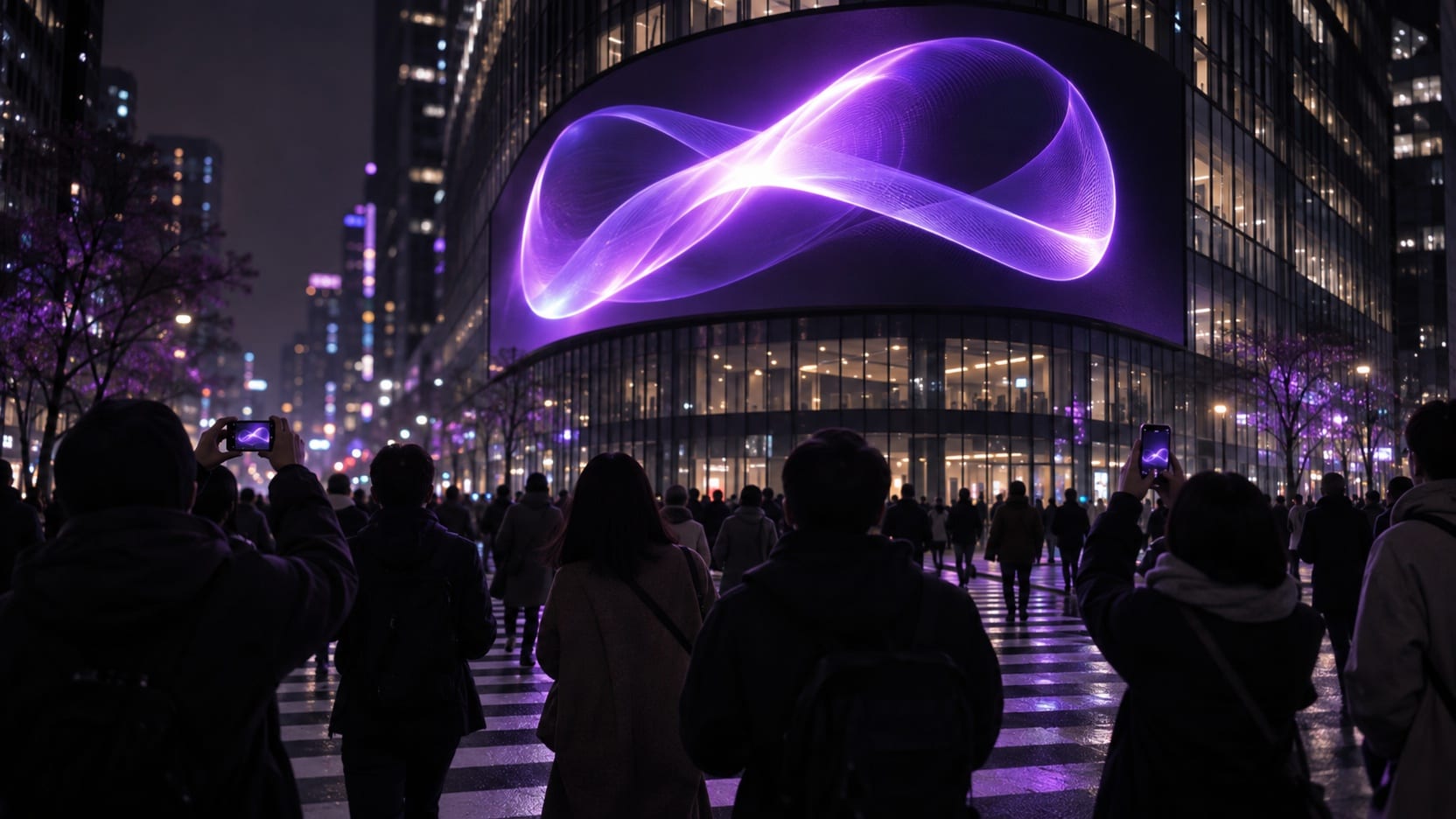
Picture this. A crosswalk on a main street at dusk. Above the people waiting for the light, a huge screen on a building corner is glowing. On the screen, something leans forward as if about to break through the wall. A few people look up. A few more take out their phones. The light changes, people cross, and a few minutes later the clip shows up in someone’s feed.
There are real cases that made scenes like this widely known. In May 2020, d’strict’s 〈WAVE〉 appeared on the LED screen covering the SMTOWN building at COEX in Samseong-dong, Gangnam-gu, Seoul. Though the screen was flat, a giant wave seemed to surge inside a glass tank and crash against the wall, and international outlets including CNN covered it. About a year later, in July 2021, a giant calico cat appeared on “Cross Shinjuku Vision,” a curved LED screen across from the east exit of Shinjuku Station in Tokyo. The cat was introduced as content promoting a new 3D advertising space, and the video spread quickly.
Both cases are often cited as the moments that introduced the term “3D billboard” to the public. But who saw these ads the most—the people who walked past them, or the people who watched them on a phone screen? Following that question makes what outdoor advertising is made for look a little different.
The illusion only works from one spot
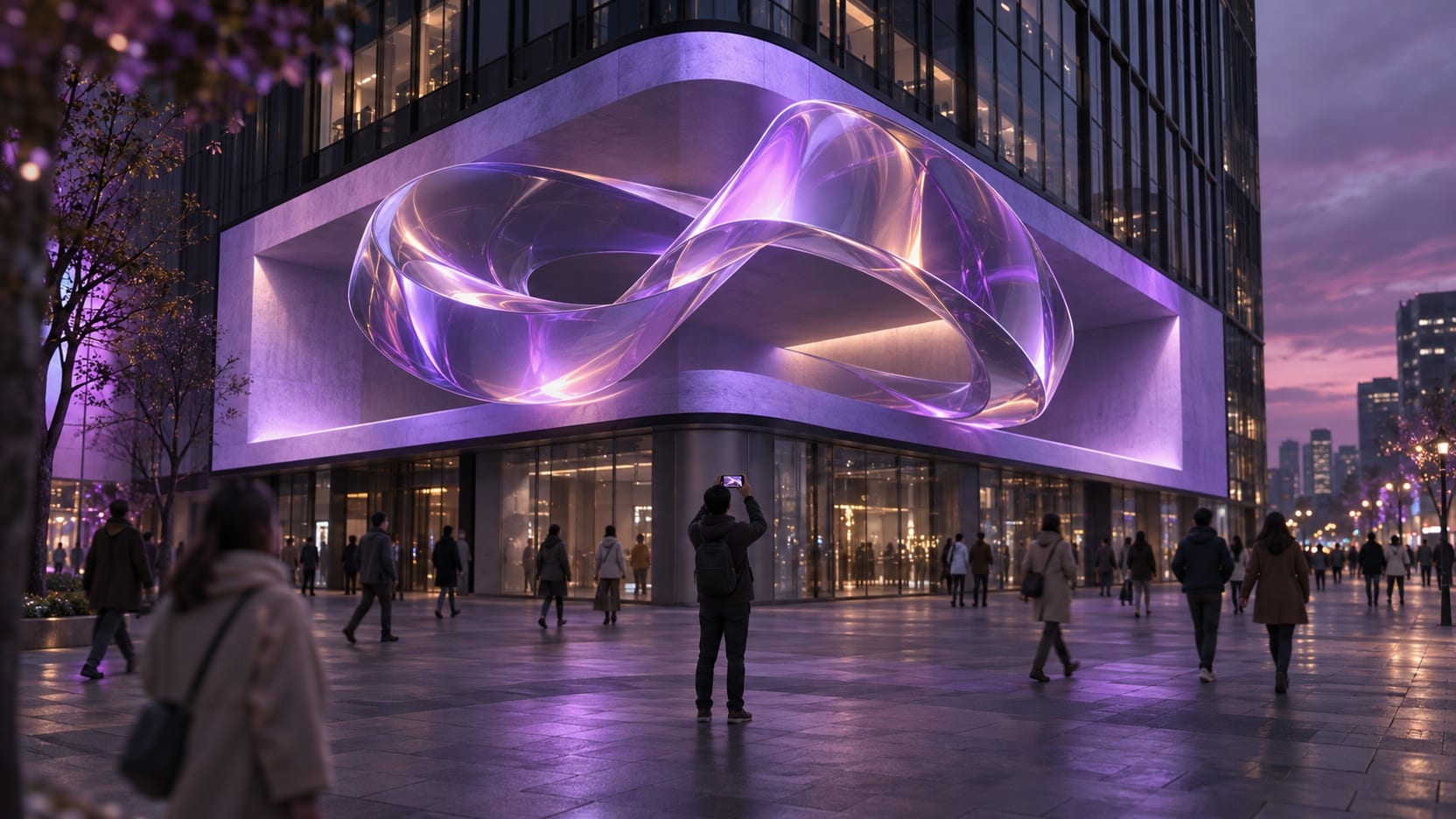
This kind of 3D effect is often called an anamorphic illusion. Perspective-calculated footage is split across two faces of a bent or curved screen so that it looks three-dimensional from a specific position. 〈WAVE〉 used a screen wrapping around a building corner; the Shinjuku cat used a curved screen. The shape of the screen is, in effect, a precondition for the illusion.
Having a calculated viewpoint also means the effect weakens once you step away from it. Directly below the screen or off to the side, the edges of the wave look stretched and the shape that seemed to leap out flattens again. Most people walking down the street don’t linger in that “right spot.” The direction they walk and the angle at which they look up all differ.
But there is one thing that stands in that exact spot most precisely: the phone camera. A video shot from a good spot keeps only the moment when the illusion lines up perfectly, and that moment reaches far more people than were ever on site. This is where the paradox arises—a street ad becomes more perfect on a screen.
An ad seen twice
That doesn’t make the street audience any less important. The Shinjuku cat had one detail worth noticing. According to Time Out Tokyo, the cat was staged to wake up at 7 a.m., when the screen switches on, and fall asleep before the screen turns off at 1 a.m. It is a setting that means nothing to someone who snaps a photo and moves on. It matters to the people who pass the same exit every day—who will see the cat awake in the morning and asleep at night.
Here the audience for a 3D billboard splits in two. One is the on-screen audience. They watch a few seconds of video shot from the best angle—no street noise, no weather, no waiting at the light. The other is the street audience. They see it from imperfect angles, briefly, but many times. The same ad becomes a completely different experience for each.
If you think only of the on-screen audience, the ad heads toward “the single most astonishing shot.” If you think only of the street audience, it heads toward “something that doesn’t get old even when you pass it every day.” The two directions sometimes overlap, but not always. People hold on longer to something that changes a little each day than to something that surprised them once. The commuter’s cat probably wasn’t memorable just because it was spectacular.
What spectacle hides
3D billboards come with conditions that are less visible. The first is time. CNN reported that 〈WAVE〉 took about four months to complete, three of them spent on digital design alone. A video whose perspective is calculated for one screen’s structure is hard to move to another screen as is. Changing the placement may mean recalculating everything.
The second is who owns the memory. The stronger the illusion, the more people remember “the wave video” or “the giant cat.” Where the brand sat within that scene is a separate matter. Whether the effect grew out of the brand’s story, or the brand name was placed on top of the effect, changes what remains after the video spreads. The equation that a widely shared video equals a widely remembered brand is an assumption that needs to be checked on its own.
The third is the fact that screens are multiplying. In Korea, under the Outdoor Advertisements Act, the Ministry of the Interior and Safety designates “Free Outdoor Advertising Zones” with relaxed regulations. The COEX area in Seoul was designated as the first zone in 2016, and in December 2023 Seoul’s Myeong-dong Special Tourist Zone, Gwanghwamun Square and Busan’s Haeundae Beach were designated as the second round. According to Segye Ilbo, following Myeong-dong and Haeundae, the displays at Gwanghwamun Square were lit on September 5, 2025, putting all three zones into operation. As large screens multiply, the surprise of “a 3D screen I’ve never seen before” becomes common. Where surprise is common, what you show matters again.
Bringing the question back to the street
If you are planning a 3D billboard, you can decide on the people before choosing the effect. Here are a few questions worth asking at that stage.
- Viewpoint — Do real people actually stand where the illusion comes together, or only cameras?
- Duration — Does a single scene finish within the time people actually stay there (waiting at a light, the few steps out of an exit)?
- Brand placement — If the video is cropped and shared, does the brand stay inside the scene?
- Repetition — For people who pass by every day, is there something different from yesterday?
Outdoor advertising was originally a medium that met people outside the screen. Now it starts outside the screen and returns into it. Somewhere in between are the people who actually crossed that street that day.
Right now, who is your ad speaking to first—the person who looked up, or the person who raised a phone?
STUDIO AVIO plans and produces advertising and brand films.
References
- CNN - Giant 3D wave sweeps over Seoul’s Gangnam District (2020.05)
- Digital AV Magazine - D’strict brings wave-shaped anamorphic technology to Coex’s LED DOOH display (2020.05)
- Time Out Tokyo - A super realistic giant 3D cat has appeared on a Shinjuku billboard (2021.07)
- designboom - 3D cat on Cross Shinjuku Vision, Tokyo (2021.07)
- Newsis - Myeong-dong, Gwanghwamun and Haeundae to become “outdoor advertising landmarks,” Korea’s Times Square (2023.12)
- Segye Ilbo - A new era for Gwanghwamun outdoor advertising… Gwanghwamun Square lights up on the 5th (2025.09)
If you'd like to plan everything from concept to distribution together, like in this post.
Start a Project